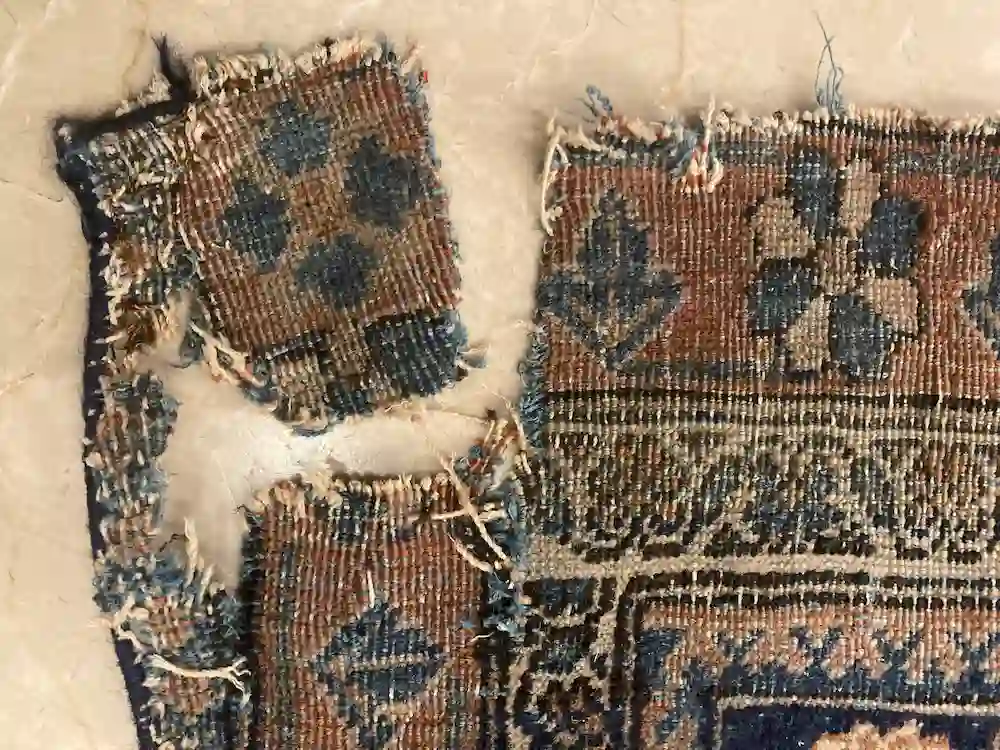
Moths in Persian rugs: how to recognise them and what to do
Moths do not make noise. They do not announce themselves, and very often you notice them only when the damage is already visible: a small hole, an area where the pile is missing, a weakened edge, or a strange fine dust under the rug.
In our shop, we sometimes say it with a smile: moths are very discreet guests, but when they pass through, they leave the bill. On a Persian rug, however, even a small sign should be looked at carefully, because the problem is not only aesthetic. It may involve the wool, the foundation, the fringes, the edges and, in more delicate cases, the value and preservation of the rug.
A Persian rug should never be read only from the front. The back, the areas under furniture, the less walked-on corners, the fringes and the edges often tell much more. Before speaking about cleaning, restoration or treatment, it is important to understand whether the damage is recent, whether the infestation is still active and how much the rug has been affected.
On a Persian rug, even a small sign deserves attention: the problem is not only the hole, but understanding whether the damage is still active and how much of the rug has been affected.
Moths and other textile insects are attracted to natural fibres, especially when they find darkness, dust, organic residues and little movement. A rug left still under furniture, stored rolled up for a long time, or not inspected regularly can become an ideal place for them.
The problem does not always come from neglect. Sometimes all it takes is a rug that has not been moved, a room that is not well aired, a hidden corner or a long period without deep cleaning. The larvae are not looking for a beautiful rug: they are looking for food and quiet.
This is why even an important, antique or well-kept rug can be affected if it remains still for too long. Prevention begins with simple habits: looking at the rug from time to time, moving it, vacuuming it carefully and checking the back as well.
Moths, textile insects and carpet beetles
In everyday language, people often speak simply of moths. In reality, rugs can also be affected by other textile insects, such as carpet beetles. The most important thing is to understand that the rug is showing unusual signs and that it is better not to wait too long.
Where they usually hide
The most exposed areas are those that are less disturbed: under a sofa, under furniture, near the edges, in corners, in rolled-up sections or in darker parts of the room. The back of the rug should also be checked.
Signs to look for: holes, missing wool and fine dust
The first sign is often a small hole. But not every hole means moths. A rug can wear because of foot traffic, furniture weight, folds, old damage or natural use.
A moth hole, however, often looks different. It may appear in areas with little foot traffic, it can be irregular and it may leave the rug looking eaten, as if part of the pile had been removed.
Holes in the pile and areas with missing wool
When larvae feed on the fibre, they can leave small areas without pile. Sometimes you can immediately see the foundation of the rug; other times you only notice a lower, lighter or less compact area.
Weak fringes and edges
Fringes and edges are not only decorative details: they are part of the structure. If they are already weak, worn or open, an insect problem can make the situation worse more quickly.
Fine dust under the rug
A fine dust, similar to sand or dry residue, can be a warning sign. It does not always mean moths, but when it appears together with holes, missing wool or small larvae, it should not be ignored.
Larvae, small insects or little moths
Seeing small larvae, insects or little moths near the rug may indicate that something is already happening. It is not enough to remove the insect you can see: you need to understand whether eggs, larvae or residues are hidden among the fibres.
What to do if you suspect moths in the rug
If you notice holes, fine dust, larvae or missing wool, the first thing is not to shake the rug in the middle of the house. This may spread residues or insects to other areas.
It is better to isolate the rug calmly, avoid improvised remedies and observe the damage. If possible, take photographs of the front, the back, the fringes, the edges and the most affected areas.
Isolate the rug without spreading the problem
If the rug is small, you can move it carefully to a separate room. If it is large, avoid dragging it or shaking it. An infested rug should not be unrolled and beaten inside the home as if it were only dusty.
Do not use aggressive products at random
Generic sprays, moth powders, bleach, ammonia, strong detergents or quick remedies can leave residues, alter the colours or stiffen the wool. On a Persian rug, especially if it is antique, fine or has silk parts, it is better not to experiment by instinct.
When to ask for a first opinion
It is useful to ask for a first opinion when you see new holes, missing wool, fine dust, weakened fringes, damaged edges or small insects near the rug. Photographs are very helpful: the whole rug, details of the damage, the back in the same area, fringes, edges and the less visible corners.
Vacuum the front and the back
Regular vacuuming helps remove dust, hair and residues that can attract insects. It should be done carefully, without aggressive brushes.
Move the rugs and check hidden areas
Moths like still and undisturbed areas. Moving the rug from time to time and checking under furniture can make problems more visible.
Storing a rolled rug
If a rug needs to be stored, it is better not to seal it in plastic for long periods. The fibre needs to breathe, and the place should be dry, clean and not too humid.
Cleaning, treatment and inspection of the rug
When moths are suspected, cleaning can be part of the solution, but it should not be decided automatically. First you need to understand what kind of rug it is, how wide the problem is and whether there are already fragile parts.
Proper cleaning can help remove dirt, residues and some of the hidden problems in the fibre. In some cases, a specific treatment may also be needed, always evaluated according to the rug.
In our shop, the starting point remains the same: first we look at the rug, then we understand which path makes sense. If you want to explore this part, you can look at the page about rug cleaning in Verona.
When the damage requires restoration
If moths have already eaten the pile, left holes or weakened fringes and edges, the matter is no longer only about prevention or cleaning. It may involve rug restoration in Verona.
Sometimes the damage is small and can be approached in a targeted way. Other times, it is necessary to understand whether the rug deserves a wider intervention. Each case should be looked at with prudence, especially if the rug is antique, fine, has silk parts or carries emotional value.
If you are in Verona
If you are in Verona and you have doubts about holes, insects, moths, missing wool or unusual dust under your rug, you can send a few photographs for a first opinion.
In our shop, in the historic centre of Verona near the Duomo, we can look at the rug calmly when seeing it in person is necessary. A photograph is not always enough, but it often helps to understand whether the problem seems superficial, active or already a damage to be evaluated.
If you notice holes, missing wool, fine dust, weakened fringes or small insects near the rug, you can send photographs of the front, the back and the affected areas. A first opinion helps to understand whether inspection, cleaning or restoration may be needed.
If the piece is a Persian or Oriental rug in Verona that you know little about, or if you fear it has been left too still for too long, a first opinion helps to understand the most prudent next step.
Frequently asked questions
How can I tell if my rug has moths?
Check for holes in the pile, areas with missing wool, fine dust on the back, larvae or small moths near the rug. Look especially under furniture, near the edges and in areas with little foot traffic.
Are moth holes different from normal wear?
Often, yes. Normal wear usually follows foot traffic. Moth damage can appear in hidden or little-used areas, under furniture or near the edges, with missing wool or small irregular holes.
Can I use moth spray on a Persian rug?
It is better not to use generic products without knowing how the wool, colours and structure will react. On Persian rugs, antique rugs, fine rugs or rugs with silk, sprays and powders can leave residues or create other problems.
Do lavender or cedar eliminate moths?
They can help as light prevention, but they should not be confused with a complete treatment. If there are already eggs, larvae or holes, the rug needs a more careful inspection.
Can a rug eaten by moths be restored?
It depends on the extent of the damage. Small holes, areas without pile, weakened fringes or edges can be evaluated for targeted restoration. It is better not to promise that the rug will look new: first, the rug needs to be seen.
How often should rugs be checked?
It is useful to check them periodically, especially if they are under furniture, rarely used, rolled up or stored in closed spaces. Lifting the corners and looking at the back can help detect the problem early.