Restoration of Persian and Oriental Rugs in Verona
The restoration of a handmade rug never begins with thread or needle. It begins with observation. The rug needs to be opened, observed from the front and back, and read through its fringes, edges, pile, weft and the way it has lived over time.
At Shahmansouri in Verona, the restoration of Persian and Oriental rugs in Verona begins from this attention. An antique rug, a fine rug, a kilim, a tribal piece or a rug for everyday use do not all need the same kind of work. Each rug carries its own materials, structure, use, earlier restoration and condition.
Restoring does not mean erasing every sign of time. It means understanding where the rug needs support, where damage may continue to spread, and where it is better to intervene with restraint, respecting the character of the piece.
When a rug arrives at the shop, the first thing is to look at it calmly. Some damage is obvious: a worn fringe, an open edge, a hole, a tear. Other issues become clear only by observing the back, the regularity of the knotting, and the strength of the weft and warp.
The back often tells as much as the front. It can reveal stiffened areas, earlier interventions, thinned sections or places where the rug has suffered more than the surface suggests.
Even touch can reveal a great deal. The wool may show dryness, stiffness, pile wear or a fibre that needs greater caution. For this reason, serious restoration should not be decided quickly, but only from the rug's real condition.
Front
It shows the most visible damage, worn areas and the general reading of the field.
Back
It helps read the regularity of the knotting and the strength of the weft and warp.
Touch
The wool can reveal dryness, stiffness and wear in the pile.
Earlier restoration
Past interventions and thinned areas help show where the piece has already suffered.
Fringes, edges and worn areas
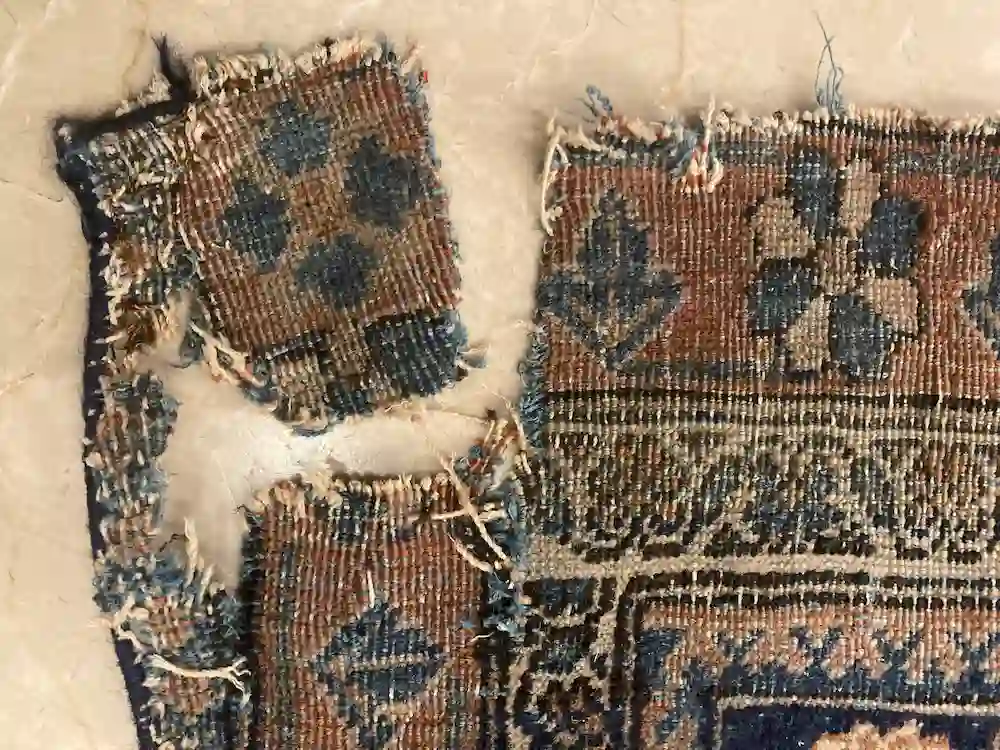
Fringes are among the first parts to show the passing of time. They may wear down, shorten, weaken or come loose. Sometimes they seem only damaged on the surface; at other times they suggest that the rug's underlying structure also needs careful attention.
Edges deserve a prudent look as well. They hold the rug together, protect the knotted area and often show whether the piece has been heavily walked on, folded, dragged or stored in less than ideal conditions.
Fringes
They may wear down, shorten, weaken or come loose, and sometimes reveal deeper problems.
Edges
They protect the knotted area and show whether the rug has been heavily walked on, folded or dragged.
Worn areas
Measured intervention can help prevent the damage from continuing into the main field of the rug.
Working on fringes and edges can help prevent the damage from moving further into the main field of the rug. Each case, however, needs to be considered in relation to the kind of piece, its age, its materials and the way it will continue to be used.
Holes, tears and weakened areas
A rug may present holes, tears, thinned sections, stiffened areas, moth damage or unsuitable earlier restoration. The problem is not always only external. Sometimes a small opening reveals a deeper fragility in the structure.
Before intervening, it is necessary to understand whether the damage affects the pile, the weft, the warp, the edge or an area already weakened by wear, humidity or unsuitable maintenance.
Holes
A small opening can reveal a deeper fragility within the structure.
Tears
They need to be read together with the weft and warp to understand whether the damage is superficial or more delicate.
Thinned areas
They can signal advanced pile wear or a section already weakened by time.
Moth damage
It is not always immediately clear on the surface and calls for a careful reading of the piece.
In some cases the rug needs only a limited intervention. In others, restoration calls for greater attention because the damaged part is tied to the structure of the piece. A direct inspection remains important precisely to distinguish surface damage from a more delicate problem.
Antique rugs, fine pieces and delicate weavings
With antique rugs and finer pieces, caution matters even more. The value of a rug does not depend only on its design or origin, but also on the quality of the materials, the fineness of the knotting, its state of preservation and the way it has been kept over time.
An intervention that is too heavy can change the character of the rug. That is why, when working on antique pieces, fine rugs, rugs with silk details or delicate kilims, it is important to understand first how much to intervene and with what measure.
A rug should not be treated like a new object to be made perfect.
Sometimes restoration needs to support a weak part. At other times it simply needs to stop wear that is continuing to spread. In every case, the rug should not be treated like a new object to be made "perfect", but like a handmade piece to be preserved while respecting its history.
Restoration and washing: when both are needed
When a rug has both deep dirt and fragile areas, the order of any work should be decided only after examining the structure. Restoration remains focused on damage; Rug Cleaning in Verona explains cleaning, dust and care of the pile.
When to ask for an inspection or send a photograph
For initial guidance, it can be useful to send a few photographs of the rug. It helps to show the whole rug, the back, the fringes, the edges and close details of any holes, tears or damaged areas.
Useful photographs to send
whole rug
back
fringes
edges
holes
tears
damaged areas
Photographs can help show whether the rug calls for a simple check, work on fringes or edges, or a more careful assessment. They are not always enough, however: the strength of the wool, stiffness, pile wear and the internal structure are better understood in person.
If you are in Verona, you can contact the shop and, when appropriate, bring the rug in for a direct inspection. Looking at it together makes it possible to understand more clearly whether it needs maintenance, washing or restoration.
Send a photograph of the rug or contact the shop for initial guidance.
Talk to us about your rug: an initial check can help you understand whether intervention is needed on fringes, edges, worn areas or more delicate damage.
Initial guidance
Do you have a rug to restore or have checked?
You can send a few photographs or contact the shop for initial guidance. A direct inspection remains important when it is antique, fine or shows structural damage.
It can be useful to ask for an inspection when you notice heavily worn fringes, open edges, holes, tears, thinned areas, moth damage or parts that seem weakened.
Does restoration make the rug like new?
That is not the goal. A handmade rug keeps its own history. Restoration should help support the piece and contain the damage, while respecting its materials, structure and character.
Can I send a photograph of the damaged rug?
Yes. For initial guidance, you can send photographs of the whole rug, the back, the fringes, the edges and details of the damaged parts. In some cases, however, seeing it in person remains necessary.
Should restoration and washing be done together?
It depends on the rug. Sometimes washing can accompany restoration, while at other times it is better to check fragile parts first. The choice has to be made according to the rug's actual condition.