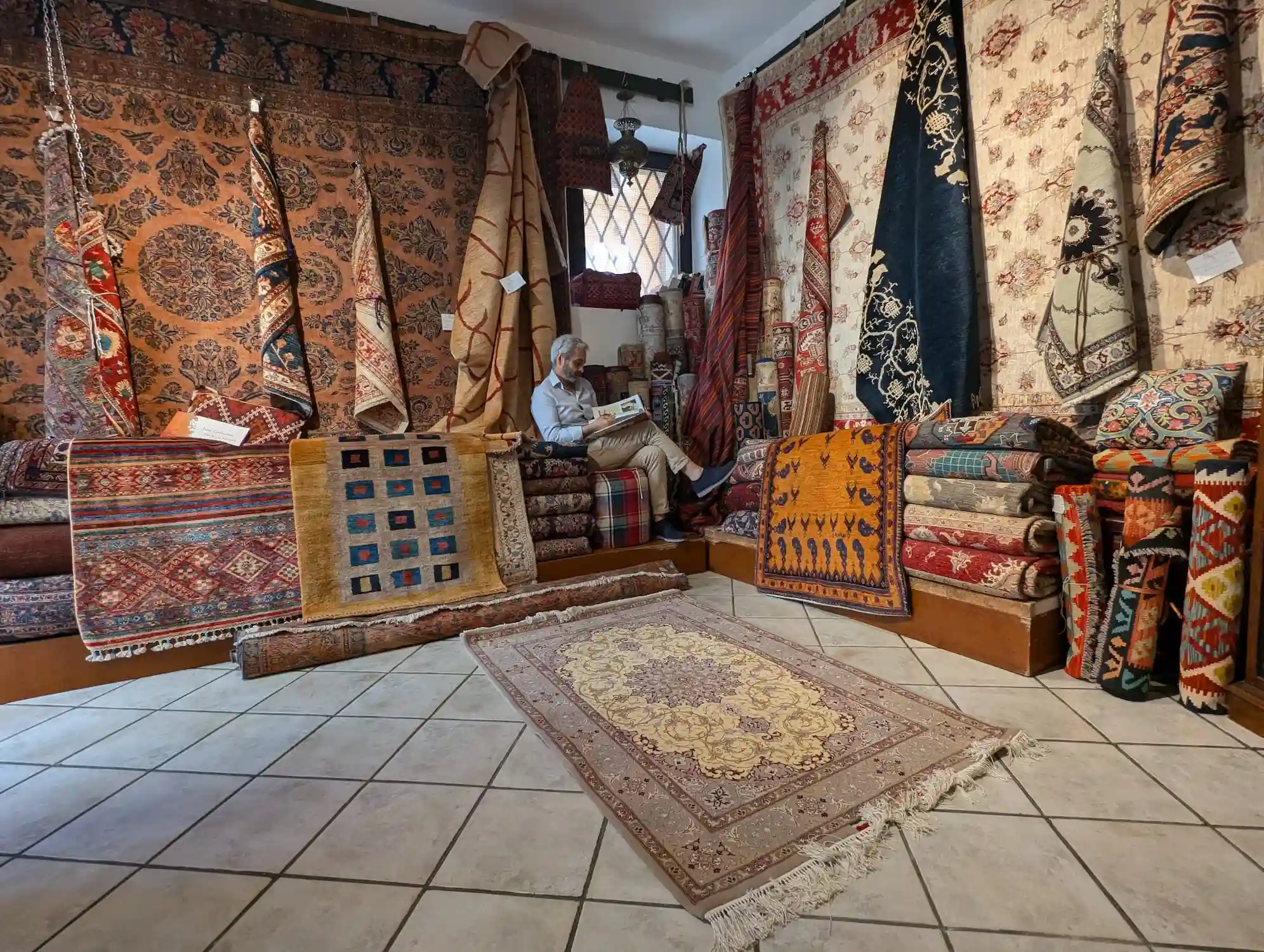
Sometimes a rug remains in the house for years without ever really being looked at. It may have been inherited, bought long ago, received through the family, left rolled up or simply lived with every day. Then a question begins to emerge: what kind of rug is it? What condition is it in? Does it need care, washing or restoration?
At Shahmansouri in Verona, it is possible to ask for free initial guidance on the rug. You can begin with a few photographs or, when appropriate, by seeing the piece in person at the shop.
A rug cannot be understood from a single image. It needs to be observed calmly: the front, the back, the pile, the fringes, the edges, the materials, the knotting, the state of preservation and any earlier restoration all say far more than a short description can.
Mehdi Shahmansouri, from the province of Isfahan, belongs to a family that has been involved in the rug trade for generations and has lived and worked in Verona since 1991. In our shop in the historic centre, near the Duomo, the relationship with the client does not stop at choosing a rug: it often continues over time through advice, maintenance, washing, restoration and care of the piece.
It is worth clarifying this from the start. Free initial guidance is meant to help begin understanding the rug, not to promise a certainty that would not be serious.
Free initial guidance
It helps bring order and understand where to begin, not settle everything in a single sentence.
Not an official appraisal
It does not replace an official appraisal, a certified valuation or an assessment with legal or insurance value.
Not a guaranteed quote
It does not imply purchase or exchange of the rug, nor a figure given without truly knowing the piece.
It should not be confused with an official appraisal, a certified valuation or a guaranteed quote. It has no insurance or legal value and it does not imply purchase or exchange of the rug.
It is a prudent initial opinion, useful for putting things in order: understanding whether the rug seems handmade, whether it may be Persian or Oriental, whether it shows antique characteristics, whether it is old or an older weaving, whether it has fragilities to observe and whether it makes sense to bring it to the shop.
Many people arrive with a family rug, a piece that has been kept for a long time, or a rug whose history they do not know. In these cases, the first step is not to speak immediately about price. First the rug needs to be opened, looked at, read for what it shows, and understood in terms of which questions it makes sense to ask.
What is observed in a rug
When looking at a rug, a frontal photograph is not enough. The design matters, but it does not tell the whole story on its own.
You observe how the rug is built, how the colours behave, how the pile has lived, whether the fringes are intact, whether the edges still hold well, whether the back shows a regular structure or earlier interventions. You also look at whether the rug has been washed, restored, folded, badly stored or worn in particular areas.
Initial guidance grows out of this set of details. Not from a single word, not from a quick promise, not from a figure given without truly understanding the piece.
Front and back
The front is the part you look at first: it shows the design, the colours, the wear in the pile and the overall impression of the rug.
The back, however, often tells as much as the front. By looking at it, you can better understand the knotting, the weft, the warp, the regularity of the structure, any earlier restoration and the points where the rug has suffered more than the surface suggests.
That is why, when photographs are sent, the back of the rug is very important. It helps avoid rushed judgments and allows the piece to be read with greater caution from the beginning.
Pile, fringes and edges
The pile tells the story of how the rug has been used. It may be compact, worn, lower in certain areas, flattened by foot traffic or made heavier by deep dust.
Even touch can reveal a great deal. A rug may appear simply dirty, but the wool can reveal dryness, stiffness, deep dust or a fibre that needs greater care.
Fringes and edges are not merely decorative details. The fringes are part of the rug's structure, while the edges help protect it. When they begin to open, wear down or lose compactness, they may show that the rug needs attention.
Materials, knotting and restoration
Wool, cotton and silk do not respond in the same way to time, use and washing. The fineness of the knotting, the compactness of the weave and the relationship between design and structure all help read the piece more clearly.
Any earlier restoration needs to be observed carefully. Some interventions were carried out with measure and accompany the life of the rug. Others may feel too stiff, too evident or not very coherent with the original structure.
That is why a rug is never looked at from only one point. Materials, back, pile, fringes, edges, knotting and state of preservation all need to be read together.
Front
It shows the design, the colours, wear in the pile and the overall impression of the rug.
Back
It helps read knotting, weft, warp, regularity and earlier interventions.
Pile
It tells of use, wear, deep dust and the true condition of the surface.
Fringes and edges
They protect the structure and often show early on when the rug needs attention.
Materials
Wool, cotton and silk help reveal how the rug has lived and how it responds over time.
Earlier restoration
It needs careful reading, because it may either accompany or alter the character of the piece.
Useful photographs to send
For initial guidance at a distance, simple photographs can be enough, as long as they are clear.
Helpful checklist
whole rug
back
pile details
fringes and edges
stains, holes or worn areas
earlier restoration
Useful photographs include:
- one photograph of the whole rug;
- one photograph of the back;
- a few close details of the pile;
- details of the fringes and edges;
- images of stains, holes, tears or worn areas;
- details of any earlier restoration or areas that do not look convincing.
It can also help to mention the approximate dimensions and explain in a few words what is known: how long the rug has been in the house, whether it comes from the family, whether it has been washed or restored, whether it stayed rolled up for a long time, or whether it presents a particular problem.
Photographs are a good first step. Sometimes they already make it possible to give useful guidance. At other times they show that it is better to see the rug in person, because colour, smell, stiffness, wear in the pile and the strength of the structure are not always fully understood from an image.
Send a few photographs of the rug for free initial guidance.
Antique rugs, old rugs and older weavings
Often the question begins in front of a rug that seems antique. But the word "antique" should be used with care. Not all old rugs are antique in the same way, and not all older weavings carry the same interest or the same state of preservation.
A rug may be important because of its age, but also because of the quality of the wool, the hand of the weaver, the beauty of the design, the colours matured over time or the way it has been kept.
Some rugs carry above all an emotional value. Others have an artisanal, decorative or historical interest. Others still need to be checked first, because fringes, edges, pile or earlier restoration can greatly change the overall reading of the piece.
That is exactly what initial guidance is for: not to apply a label too quickly, but to understand where to begin. If you would like to explore this aspect further, you can also see the page on Antique Rugs in Verona.
What initial guidance may reveal
Initial guidance does not automatically prescribe an intervention. It may show that nothing is urgent, that the rug should be examined more closely in person or that the concern belongs to a specialist service.
When dirt, dust or odours are the main concern, the relevant path is Rug Cleaning in Verona; when fringes, edges or structural areas are damaged, the reference is Rug Restoration in Verona.
No immediate intervention
Not every rug calls for an urgent step: sometimes it simply needs to be understood better first.
Washing
It may be useful when dust, odours or deep dirt genuinely change the reading of the piece.
Maintenance
A check over time can help stop small issues before they spread further.
Targeted restoration
Fringes, edges, fragile areas and earlier work may need a more precise reading.
When it is better to come to the shop in Verona
Photographs help, but they are not always enough. When the rug shows heavily worn areas, earlier restoration, stiff sections, silk, fragile fringes, open edges or doubts about the structure, seeing it in person remains the most prudent step.
In our shop, in the historic centre of Verona near the Duomo, we can open the rug and look at it together calmly. This makes it possible to read the front and back, materials, pile, fringes, edges and state of preservation more clearly.
This is not about selling an instant certainty. It is about giving the owner of the rug a first clear and serious point of reference, so they can understand what is in front of them and what the next step may be.
Contact the shop or visit the showroom in Verona for initial guidance on your rug.
Initial guidance
Would you like initial guidance on your rug?
You can send a few photographs or contact the shop. When needed, seeing the rug in person makes it possible to read the front, the back, the pile, the fringes, the edges and the state of the piece more clearly.
No. It is an initial opinion on the rug and does not replace an official appraisal, a certification or an assessment valid for legal or insurance purposes.
Can I know straight away how much my rug is worth?
Not in a serious or guaranteed way. Before speaking about value, the piece needs to be understood: materials, knotting, back, pile, fringes, edges, state of preservation and any earlier restoration.
What photographs should I send?
Useful photographs include one of the whole rug, one of the back, a few details of the pile, the fringes, the edges and any damaged, stained or previously restored areas.
If the rug is damaged, should it be washed or restored first?
It depends. In some cases washing may help, in others restoration, and in others simply an inspection. Before intervening, it is better to observe the rug and understand its actual condition.