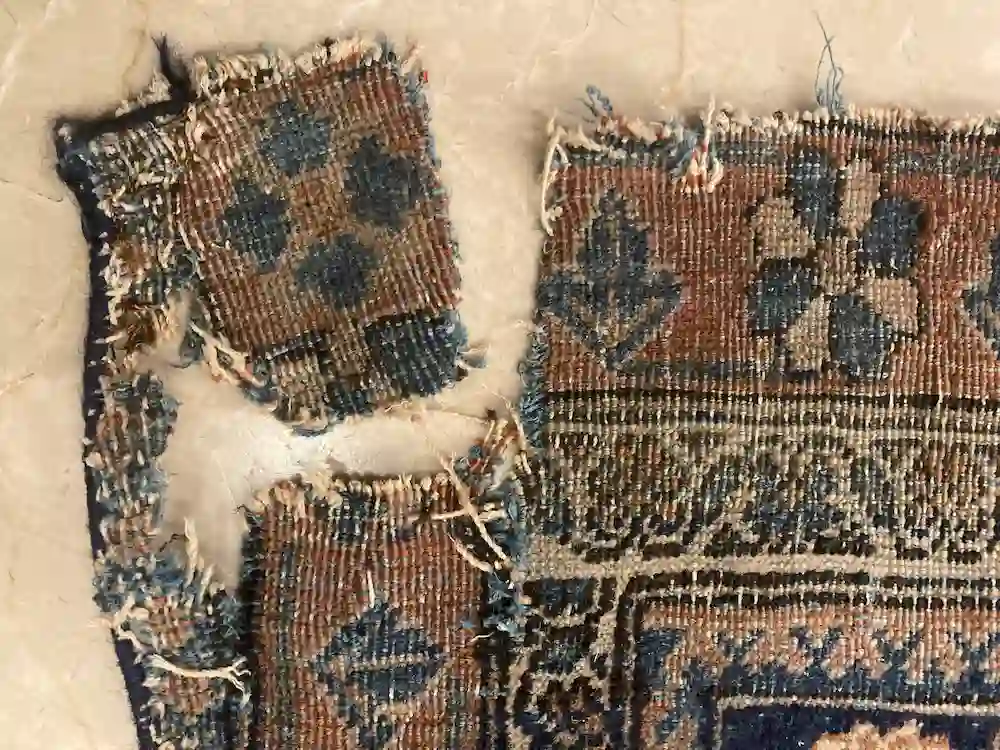
Red wine on a Persian rug: what to do immediately without making the stain worse
When red wine falls on a Persian rug, the first reaction is often to run for salt, water, vinegar or any stain remover at hand. It is understandable, but on a handmade rug, haste can create more damage than the stain itself.
The first rule is simple: absorb immediately, without rubbing. The wine should be lifted from the pile as much as possible, without pushing it deeper and without spreading the halo.
A Persian rug is not an ordinary surface. Wool, silk, warp, weft, back, fringes and edges can react differently to moisture, heat and household products. This is why the first step should not try to “remove everything” at once, but to limit the damage.
If the rug is antique, fine, has silk parts, has already been restored, is a kilim, or if the colours seem to move, it is better to stop early. First the piece is observed, then the next step can be chosen with care.
In the first minutes, limiting the damage matters more than removing the stain
Place a clean white cloth or white absorbent paper on the area immediately. Press gently, without dragging the cloth through the pile. Change sides often, so that you do not put wine back onto the rug.
The gesture should be firm but light. Blot, absorb, change the cloth and repeat. Do not rub, scrape or brush.
If the rug is small and you can do it without deforming it, also check the back in the corresponding area. If the wine has passed through, the problem no longer concerns only the surface.
How to blot correctly
Blotting means placing and pressing, not rubbing. Rubbing can open the pile, push the wine deeper and stress the colours.
Which cloth to use
Use white absorbent paper or a soft white cloth. If the cloth immediately stains with wine, change it. If colour from the rug also appears on the cloth, stop.
Can I use water or not?
If the rug is wool, robust, relatively recent and shows no colour instability, you may consider a very small amount of cold water on a cloth, never poured directly onto the rug.
What to avoid on a Persian rug
Some very common remedies are not suitable for a Persian rug. The fact that they may work on a tablecloth, a carpet or a synthetic rug does not mean they are safe on a hand-knotted piece.
Avoid rubbing. Avoid hot water. Avoid steam cleaners, hot hair dryers, bleach, ammonia, degreasers and universal stain removers. Also avoid trying many products one after another.
Sometimes the most serious damage does not come from the wine, but from the cleaning attempts that follow.
Why you should not rub
The wine can go deeper, the pile can deform and the colour can be stressed in an uncontrolled way. It is better to do less, but do it well.
Salt, baking soda and vinegar
They are not automatic remedies. Before adding any product, it is important to understand how fibre, colour and back are reacting.
Why steam is risky
Steam combines heat and moisture. On Oriental, Persian, antique or delicate rugs, it can create problems for colours, wool, silk and old restorations.
Why red wine is delicate on wool, silk and colours
Red wine is an insidious stain because it colours, penetrates and can leave a halo. If it remains too long in the pile, it can descend toward the base of the knots and, in more serious cases, reach the back.
What is visible on the surface is not the only thing that matters. It also matters how much wine has been absorbed, how long it has been there, whether the area has been rubbed, whether products have been used and whether the rug has stable colours.
Halo, penetration and the back of the rug
After blotting, observe the area calmly. If the halo spreads, if the back is damp or if the rug changes consistency, the problem may be deeper. The back of the rug often tells as much as the front.
Fresh stain and already dry stain
A fresh stain should be absorbed immediately. A stain that has already dried, however, should be handled with even more caution: insisting with water or products may reactivate the halo or move the colour.
Unstable colours and already restored rugs
If colour transfers onto the cloth, stop. The same applies if the rug has old restorations, stiff areas, darned parts, weak fringes or worn edges.
Wool
A robust wool rug may tolerate a small accident better, but it is not indestructible.
Silk
Silk requires far more caution. A wet or badly rubbed area can change light, consistency and appearance.
Kilims and flatweaves
Liquid may spread through the weave differently than in a knotted rug.
Antique rugs
It is better to limit the damage, stop early and observe the piece before continuing.
When it is better to stop and ask for advice
It is better to stop when the rug is antique, fine, silk, already restored, when the colour moves, when the back is damp or when a visible halo remains.
It is also better to ask for advice if the area becomes stiff, sticky, darker, or if after a few hours the rug shows an odour or a change in the pile.
A first opinion should not be confused with a promise of result. It helps to understand the most prudent step: let it dry, consider professional washing or check for more delicate damage.
When professional washing may be needed
Professional washing may be useful when the wine has penetrated, when the back is damp, when a halo remains, when the area has been treated at home with unsuitable products or when the rug is delicate.
Washing should not be decided at random. First the rug is looked at: pile, colour, back, fringes, edges, materials and general condition. To learn more, you can visit the page about rug washing in Verona.
When restoration may also be needed
If the stain has affected fringes, edges, already weak areas, old restorations or parts that have lost consistency, the problem may no longer be only about cleaning.
Washing and restoration are not the same thing. Washing concerns dirt, stain, pile and freshness of the piece. Restoration concerns worn, weakened or damaged parts. In these cases, it may be useful to understand more about rug restoration in Verona.
Which photographs to send for a first orientation
For a first orientation, simple and clear photographs taken in natural light can be very helpful.
The most useful images are:
- the whole rug;
- the stain seen up close;
- the back in the corresponding area;
- fringes and edges near the stain;
- any old restorations or already weak parts;
- a detail of the pile;
- a brief indication of how much time has passed;
- a note about what has already been done at home.
Photographs help to understand whether the problem seems superficial or whether it is better to see the rug in person. If the rug is a Persian or Oriental rug in Verona that you do not know well, or if you fear you may have treated it incorrectly, a first orientation helps to understand the most prudent step.
If you are in Verona
If you are in Verona and red wine has fallen on a Persian, Oriental, antique, fine or silk rug, you can send a few photographs for a first orientation.
In our shop, in the historic centre of Verona near the Duomo, we can look at the rug calmly when an in-person view is needed. A photograph is not always enough, but it often helps to understand where to begin.
If a halo remains, if the back is damp, if the colour has changed or if you have doubts about the rug’s reaction, you can send photographs of the front, the back and the affected area. A first orientation helps to understand whether only caution, washing or a more careful check is needed.
Washing, restoration or first orientation
Not every case requires the same intervention. If the problem mainly concerns wine that has entered the pile, a halo or odour, it may be useful to learn more about rug washing in Verona.
If fringes, edges, weakened areas, old restorations or parts that have lost consistency are involved, it may be necessary to understand whether a check related to rug restoration in Verona is also needed.
If you do not know what kind of rug you have, if it is antique, fine, silk, or if you fear you may have used the wrong product, the first step can be a free first orientation for your rug.
Contact the shop or send a few photographs: first the piece is understood, then the next step is chosen with care.
Frequently asked questions
Should I blot or rub?
Blot, do not rub. Rubbing can push the wine into the pile, spread the halo and stress colours and fibres.
Can I use water on a Persian rug?
Only with great caution and in a very small amount, preferably on a cloth and not directly on the rug. With silk, antique rugs, kilims or delicate colours, it is better to stop first.
Is cold or hot water better?
If water is needed at all, cold water is safer. Hot water can create problems for fibres, colours and organic stains.
Can I use salt?
It is better not to consider it an automatic remedy. On a Persian rug, salt may be abrasive and is not suitable for every handmade piece.
Can I use baking soda?
Not as an automatic solution. Baking soda appears in generic home-cleaning advice, but on Persian, antique or delicate rugs it should be used only with great caution.
Can I use vinegar?
Not as a standard remedy. Even diluted vinegar can create problems on delicate colours, silk, antique rugs or pieces whose reaction is unknown.
Can I use steam?
No. Steam is risky because it combines heat and moisture, two delicate factors for Persian, Oriental, antique or silk rugs.
When should I ask for advice?
When a halo remains, the back is damp, the colour moves, the rug is antique, fine, silk, already restored, or if household products have already been used.