Rugs and underfloor heating: how to choose with care
Today many homes have underfloor heating. It is comfortable, clean and often very pleasant to live with. Then, naturally, one question comes up: can I place a Persian rug on a heated floor?
The short answer is yes, but not with every rug and not in every way. A handmade rug can live with underfloor heating, as long as thickness, materials, structure, backing and underlay are considered carefully.
In our shop, we often say that choosing a rug is not only about looking at the design. It is also about understanding where the rug will be placed, how much light the room receives, what kind of floor there is and, in this case, how the heating system works.
A Persian rug, a kilim, a wool rug, a fine rug or an antique piece will not all react in the same way. For this reason, the choice should be made with care, without alarmism but also without oversimplifying.
With underfloor heating, the point is not only placing a rug, but choosing the right one: thickness, materials, backing and breathability really matter.
Yes, in many cases they can. The important point is to choose rugs that do not block too much heat and do not have materials or backings that are unsuitable for constant warmth.
Every rug adds a layer between the floor and the room. If that layer is light, natural and breathable, heat can pass through more easily. If, instead, the rug is very thick, heavy, synthetic or has a rubber, latex or glued backing, it can insulate too much and create problems.
So the right question is not only "can I place a rug there?", but "which rug can I place there?".
Why material and thickness matter
On underfloor heating, it is better to choose rugs that are not too thick, with a low pile or flatwoven structure. A very high, dense or long-pile rug holds more heat and can reduce the efficiency of the heating system.
Wool, cotton and some natural fibres can be more suitable, especially when the rug is thin and breathable. Synthetic materials should be considered with more caution, especially when combined with glued backings, rubber, latex or poorly breathable supports.
Here too, there is no single rule. A very thick wool rug can insulate too much; a thin wool rug can be much more suitable. The material matters, but the structure matters too.
Wool rugs
Wool is a natural fibre and, when the rug is not too thick, it can work well with underfloor heating. Wool, however, is naturally insulating: this is one of the reasons why it feels so pleasant in the home.
For this reason, on a radiant heated floor it is better to choose wool rugs with a low pile, moderate weight and a breathable structure.
Kilims and flatwoven rugs
Kilims and flatwoven rugs are often a good choice because they have little thickness and no high pile. Their lighter structure allows heat to pass more easily.
A kilim, however, should still be looked at carefully: materials, condition, possible old restorations and the way it lies on the floor remain important.
Fine, antique or silk rugs
With antique rugs, fine rugs or rugs with silk parts, more caution is needed. This does not mean they are always forbidden on underfloor heating, but they should be observed more carefully.
Continuous warmth, even when moderate, can affect fibres that are already delicate, old restorations, stiffened areas or more sensitive materials. Before placing an important rug on a heated floor, it is better to ask for advice.
The back of the rug matters as much as the front
When we speak about underfloor heating, the back of the rug becomes very important. A handmade rug, without synthetic backing, often breathes better than many industrial rugs with latex, rubber or glued bases.
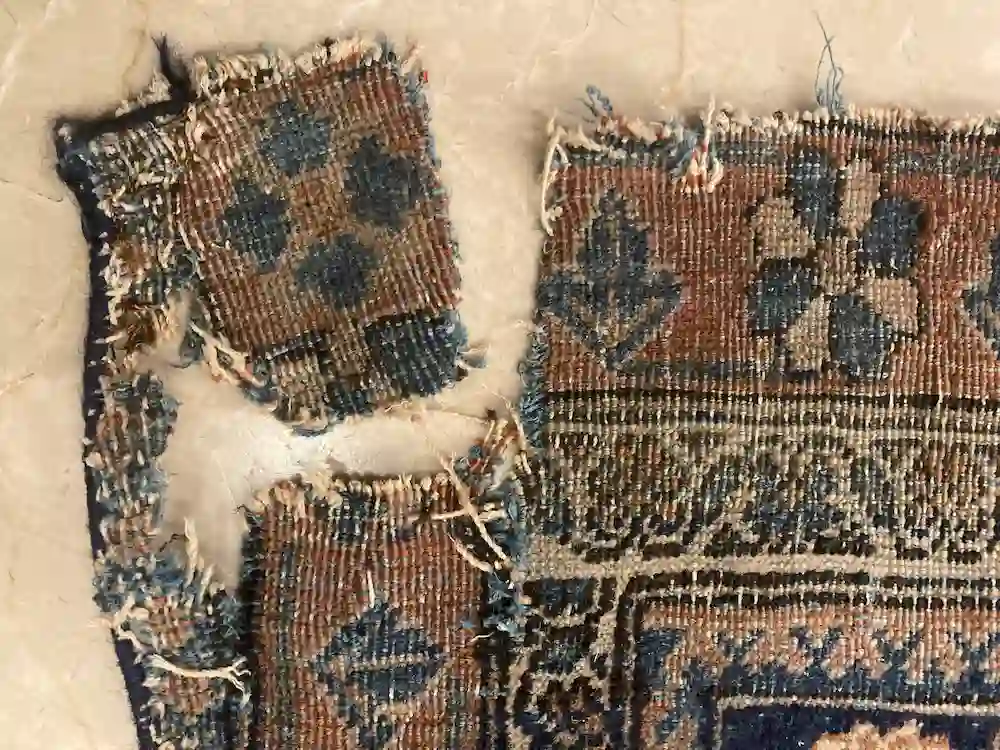
In a handmade rug, the structure is visible: warp, weft, knots and weaving. In industrial or tufted rugs, instead, there may be a glued or rubberised backing that can deteriorate with constant heat, become sticky or leave residues on the floor.
For this reason, before choosing a rug for a home with underfloor heating, it is worth turning it over. As often happens, the back tells a great deal.
Underlay: when it helps and when it can cause problems
An underlay can help keep the rug in place, but on underfloor heating it must be chosen with great care.
Underlays that are too thick, made of heavy felt, rubber, latex or synthetic foams can block heat. In some cases, over time, they may also deteriorate or leave marks on the floor.
If an underlay is needed, it is better to choose a light, breathable solution that is compatible with heated floors. In many cases, especially with kilims or rugs that lie well, it may be better to avoid underlays that are too insulating.
Which rugs to choose for underfloor heating
In general, the most suitable rugs for underfloor heating are:
thin rugs;
low-pile rugs;
kilims and flatwoven rugs;
wool rugs that are not too heavy;
rugs with a natural and breathable back;
handmade pieces without rubber, latex or synthetic glued backing;
rugs proportionate to the room, without covering the whole floor.
The choice should always be made by looking at the actual rug, not only at the category. Two "wool rugs" can behave very differently if one is thin and the other is very thick.
What to avoid
It is better to avoid very thick rugs, shaggy rugs, long-pile rugs, synthetic padding, rubber or latex backing, glued bases and underlays that are too insulating.
Also pay attention to rugs that cover almost the whole room: underfloor heating works better when heat can spread. One large, very insulating rug can reduce the performance of the system and create warmer areas underneath.
It is not a matter of fear, but of common sense: the rug should accompany the home, not force the heating system to work badly.
The floor underneath the rug
The rug is not the only thing that matters. The floor matters too: wood, laminate, stoneware, stone and other materials do not all react in the same way.
Wood and some laminates may be more sensitive to heat trapped under very insulating rugs. Stoneware and stone are generally more stable, but even there it is better not to cover everything with heavy and poorly breathable materials.
If the floor manufacturer gives specific indications, they should be respected. The rug should work with the floor, not against it.
Persian rugs and underfloor heating
Many handmade Persian and Oriental rugs in Verona can be suitable for a home with underfloor heating, especially when they have moderate thickness, a pile that is not too high and a natural structure.
One advantage of handmade rugs is that they often do not have synthetic backing applied to them. This can make them more breathable than some industrial rugs. But even a Persian rug should be chosen carefully: origin, thickness, materials, age, condition and where it will be placed in the room are all elements to consider.
In the shop, when choosing a rug for a modern home with radiant floor heating, it makes sense to mention it immediately. This helps avoid choosing a beautiful rug that is not ideal for that particular environment.
When to ask for advice
It is useful to ask for advice when the rug is antique, very fine, has silk parts, is very thick, has already been restored, or when the floor is wood or another delicate material.
It can also help to bring the room measurements, the type of floor and, if possible, some information about the heating system. There is no need to become too technical: what matters is understanding the context in which the rug will be used.
In our shop, in the historic centre of Verona near the Duomo, we can help you understand which rugs may be more or less suitable for a home with underfloor heating.
Yes, in many cases it is possible, especially if the rug is not too thick, has a low pile and a natural, breathable structure. The individual rug should still be evaluated.
Is wool suitable for underfloor heating?
Wool can be suitable, but thickness and structure matter. A thin, low-pile wool rug is more suitable than a very thick or very dense rug.
Are kilims suitable for underfloor heating?
Often, yes. Kilims and flatwoven rugs have little thickness and allow heat to pass more easily. Materials, condition and intended use should still be checked.
Do I need an underlay?
Only if necessary, and only if it is compatible with underfloor heating. It is better to avoid thick underlays, rubber, latex or materials that insulate too much.
Can a rug that is too thick reduce the heat?
Yes. A very thick or very insulating rug can hold heat and reduce the efficiency of the heating system. This is why low-thickness rugs are usually preferable.
Are rugs with rubber backing recommended?
It is better to avoid them. Rubber, latex and glued backings can react badly to continuous heat and, in some cases, leave residues or damage the floor.